AI may have just cracked one of the hardest open problems in mathematics: Navier–Stokes.
AI may have just cracked one of the hardest open problems in mathematics: Navier–Stokes.
And the story behind it is getting more interesting.
Tristan Buckmaster says OpenAI told him its internal research model had generated a roughly 100-page proof.
The proof has not been made public or independently verified.
Here’s the context:
→ Buckmaster and Levent Alpöge spent about a year working on a very specific approach in this area, using Claude and Codex as research tools.
→ In August, they made major new progress and formally verified part of their work in Lean.
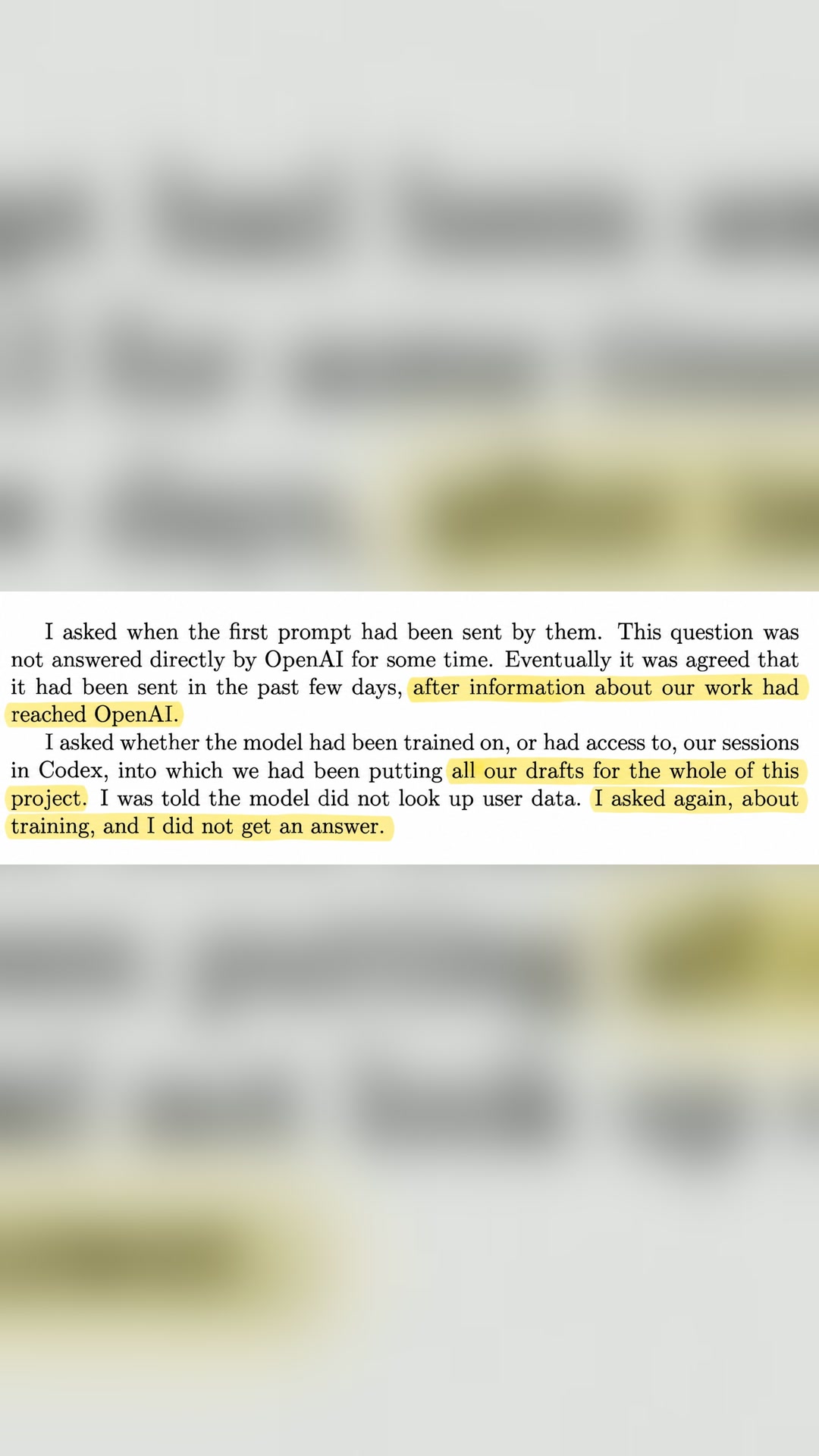
→ Buckmaster says information about their progress reached OpenAI.
→ A few days later, OpenAI researchers told him their internal model had reached Navier–Stokes through smooth forcing, a direction Buckmaster says closely matched the unusually specific route he and Alpöge had been pursuing.
→ And this is where it gets strange: their unpublished project drafts had been going into Codex throughout the project.
→ Buckmaster asked whether OpenAI’s model could have been trained on those sessions. He says he was told the model did not directly look up user data, but never got an answer to the separate question about training.
→ He explicitly says he does not know whether their data was used.
And the story didn’t end there.
Buckmaster says a dispute followed over how the result should be published and who should get credit, including a proposal that would leave Alpöge, who works at Anthropic, off the paper.
OpenAI’s Sebastien Bubeck disputes Buckmaster’s account.